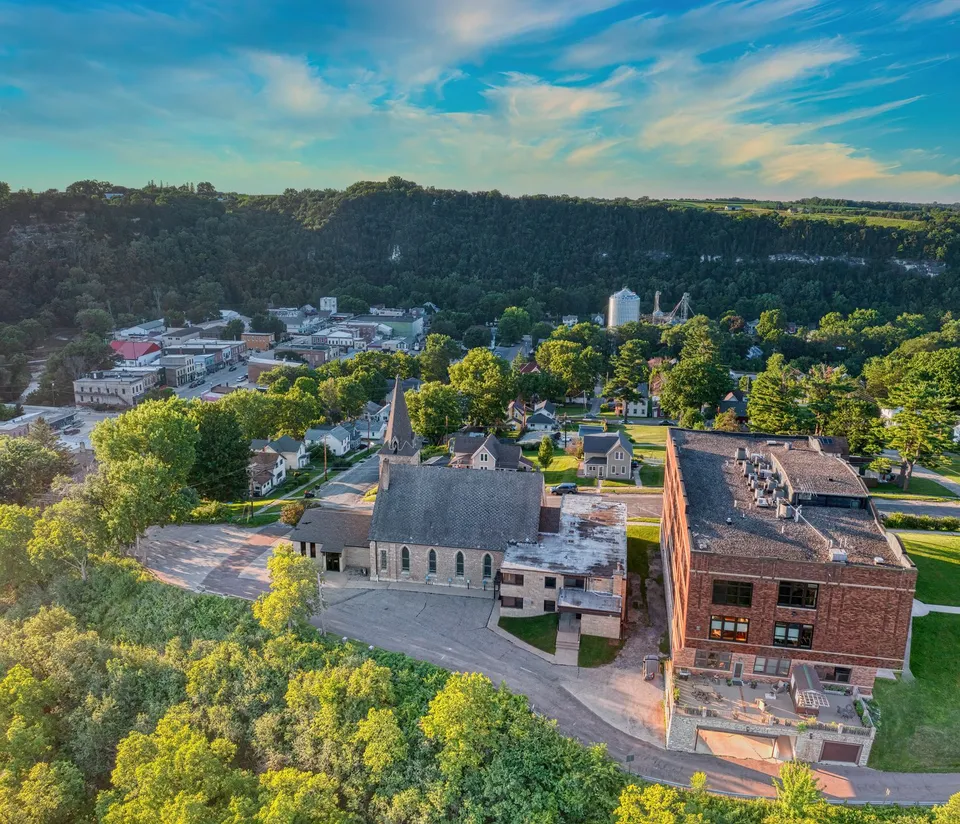
Hibbing is easier to understand when you stop looking for one big center of gravity and start reading its public places. The city says it was established in 1893, became known as the “Town That Moved,” and shifted south in the 1920s after iron ore was discovered under the old site; the move involved more than 180 houses and 20 businesses and cost about $16 million. That history still shows up in the Hull Rust Mine View, the Hibbing Historical Society and Museum, and the city landmarks that grew out of the move. For newcomers, that matters because the town’s work life, school life, and weekend life are still organized around institutions rather than around a single commercial strip.
1. The mine view is a local lesson, not just a sightseeing stop
The Hull Rust Mahoning Mine View does more than give Hibbing a recognizable landmark. It explains why the region’s identity, hiring patterns, and public services have long been tied to heavy industry and the support work around it. The city’s facts-and-history page places the mine view alongside the Greyhound Bus Museum, the Paulucci Space Theatre, and the Bob Dylan Collection & Exhibit, which tells you something important: Hibbing expects people to learn the town through public institutions, not through a single entertainment district. That is useful for job seekers and employers alike, because it helps frame why fabrication, maintenance, public service, transportation, and healthcare support keep showing up in local conversations.
For a resident who just accepted a job offer, the mine view also gives fast context for the geography of the place. Hibbing’s history is not an abstract background detail; it is part of the daily map. The old townsite, the museum pieces, and the rebuilt civic core show why local routes, public buildings, and neighborhoods feel spread out compared with a compact downtown city. That is one reason Hibbing can feel both small and regional at the same time.
2. The campus is where Hibbing turns history into practical training
Minnesota North College’s Hibbing campus is one of the clearest signs that the town’s future is still being built locally. The campus says Hibbing opened a junior college in 1916 and moved to the current campus in 1969, and its program list includes paths that line up directly with regional work: Automotive Technician, Diesel Mechanics & Heavy Equipment, Electrical Maintenance & Construction, Nursing, Medical Lab Technician, IT Networking & Security, Construction Management & Supervision, Culinary Arts/Food Service Management, and Peace Officer Education. It also offers transfer-oriented degrees in areas like business, biology, psychology, history, and sociology.
That mix matters because it gives students and adult learners a local route into both immediate jobs and longer-term credentials. Minnesota North says the Hibbing campus offers adult learning options, including a reduced rate for Minnesota residents age 62 or older. The campus also serves as a base for Upward Bound, which works with students from Hibbing, Chisholm, and Nashwauk-Keewatin and includes college visits, paid internships, tutoring, advising, and career exploration. In other words, Hibbing’s training pipeline is not a vague promise; it is a concrete set of doors that open at different ages and for different kinds of workers.
Chisholm adds a useful comparison. Its high school curriculum includes welding, automotive technology, construction, nursing/EMT, pre-engineering, and CNA certification through College in the Schools. That helps explain why employers in the western Mesabi can recruit from a wider local skill base without expecting every worker to leave the range for training first.
3. Community education is the after-hours map for settling in
If the mine view explains where Hibbing came from and the campus explains where training happens, community education explains how people start belonging. Hibbing Community Education says it serves everyone from the youngest child to the senior adult and keeps class offerings in the Hibbing Community PIE, the Hibbing Daily Tribune, and through partners such as the Hibbing Public Library, Hibbing Parks and Rec, the Hibbing Chamber, and Chisholm Community Education. That makes it a practical resource for newcomers who want to meet people, keep children engaged, or build a routine outside work hours.
This is one of the town’s quieter strengths. In larger places, the social calendar can feel scattered across private gyms, expensive studios, or niche clubs. In Hibbing, recurring classes and partner organizations create a more legible path into community life. For an employer, that can help a new hire settle faster. For an applicant, it can make a relocation feel less like a leap and more like a sequence of manageable steps.
Why this matters if you are working here
Hibbing works best when you read it as a network: a historic city center, a working campus, and public programs that keep residents connected after hours. That is useful for applicants deciding whether to move, for employers trying to understand local turnover, and for families trying to picture day-to-day life. The town’s public institutions are not side notes; they are part of the labor market itself.
If you are new to Hibbing, start with one local landmark, one training resource, and one community program. That small circuit will tell you far more about the town than a generic map ever will. For more local orientation, browse the community section at HibbingJobs and then build from there.