In many places, schooling and hiring sit in different conversations. In Hibbing, they are closer than that. A family choosing a school path, a student deciding whether to take welding or nursing prep, and an employer wondering where the next reliable hire will come from are all looking at the same local system. Hibbing Public Schools organizes students through Washington Elementary, Lincoln Elementary, Hibbing High School, and the Hibbing Early Learning Center, while Chisholm High School adds a distinctly applied menu of electives and College in the Schools options. Together, those institutions shape who is ready to work, who is ready to retrain, and who can stay local while doing it.
What the local pipeline actually looks like
The most useful thing about Hibbing’s education network is that it is not abstract. The district structure starts early, with the Hibbing Early Learning Center serving birth through age 5, then moves through Washington Elementary for grades K-1, Lincoln Elementary for grades 2-5, and Hibbing High School for grades 6-12. That matters for workers because childcare, school placement, and family logistics are not side issues; they shape whether someone can accept a shift, attend training, or keep a job that starts before 8 a.m. or ends after 5.
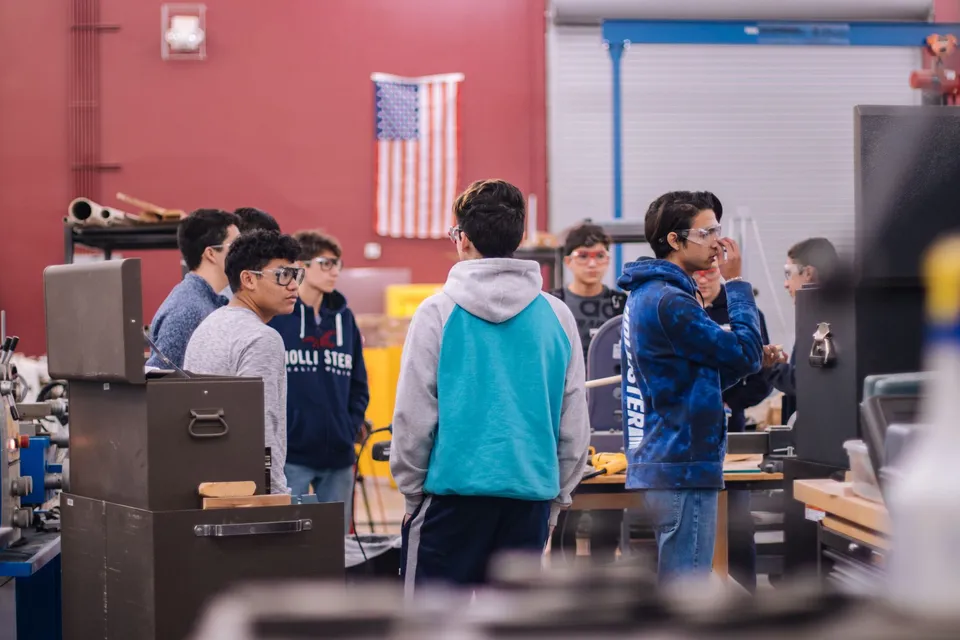
Chisholm’s high school shows what a more hands-on secondary pathway can look like in the western Mesabi. The school serves grades 7-12 with about 330 students, typically two or three sections per grade, and class sizes ranging from 15 to 30. Its electives include welding, automotive technology, construction, laser production, computer technology, nursing/EMT, pre-engineering, chemistry/physics, advanced math, and environmental science. It also offers College in the Schools classes such as construction careers, cabinet making, welding, and CNA certification. That is not just a broad curriculum; it is a preview of local work in shops, fleets, clinics, job sites, and technical colleges.
Why employers should pay attention to the classroom
For employers, the point is not that every graduate is job-ready for every role. The point is that the region is already giving students exposure to equipment, teamwork, credentials, and applied problem-solving before they ever fill out an application. A student who has taken welding, automotive, construction, or nursing-related coursework has a better chance of understanding shop safety, patient-care routines, or the pace of a production floor. A student who has worked through advanced math, pre-engineering, or computer technology has a stronger base for maintenance, dispatch, lab support, or office operations.
Minnesota North College’s Hibbing campus extends that pipeline into postsecondary training. Its program list includes Automotive Technician, Business Operations & Management, Construction Management & Supervision, Culinary Arts/Food Service Management, Dental Assistant, Diesel Mechanics & Heavy Equipment, Electrical Maintenance & Construction, Fitness Specialist, IT Networking & Security, Medical Lab Technician, Nursing, and Peace Officer Education, along with transfer pathways in liberal arts and sciences. The key local insight is that these programs line up with the work already common in the area: public service, transportation, healthcare, maintenance, equipment repair, and office support. The campus also offers adult learning, including a reduced rate for Minnesota residents age 62 or older, which makes retraining more realistic for workers who are changing fields later in life.
The support systems that decide whether people can use those paths
A training pipeline only works if families can actually get to it. St. Louis County says it licenses family child care homes and offers child care assistance for families who need help paying for care while working, looking for work, or attending school. It also notes a Hibbing Annex location for child care assistance. That detail matters because many job seekers do not need a motivational speech; they need a practical way to cover childcare while they accept a new shift, enroll in a class, or bridge a few weeks between jobs.
Transportation is part of the same equation. Arrowhead Transit’s Hibbing service connects riders to the broader Arrowhead and tells them to schedule trips through the system rather than treat transit as an afterthought. In a region where school schedules, clinic visits, part-time work, and training can all fall on different clocks, transit is not just a convenience. It can be the difference between a job that works on paper and a job that works in real life.
Digital access is becoming another hidden requirement. The local broadband grant described in the research report would extend fiber service to 444 unserved households, 7 unserved businesses, 1 unserved community anchor, 116 underserved households, and 5 underserved businesses, with the goal of improving work-from-home, e-commerce, distance learning, and telehealth. For applicants and employers alike, that means training videos, online onboarding, remote support tasks, and home-based side income depend on more than a phone signal. They depend on whether the address can handle modern service.
What this means for someone moving for work
If you are relocating to Hibbing or Chisholm for a job, the smartest way to read the local economy is to think in systems, not just openings. A good role may depend on a bus route, a child care slot, a technical class, or a home internet upgrade as much as on wages alone. That is why the schools, college campus, county child care office, and transit network belong in the same mental map as the employer list. The region’s strongest advantage is that it offers real paths between entry-level work, retraining, and more specialized jobs without forcing people to leave the area first.
For employers, that is good news too. It means recruiting can be local, realistic, and specific. A shop hiring a mechanic, a clinic hiring support staff, a school district hiring aides, or a public agency hiring operators is not starting from zero. It is tapping into a school-and-college system that already teaches applied skills, plus a county support structure that helps families manage care, travel, and training. The most effective hiring strategy in Hibbing is to treat those institutions as part of the workforce, not as background scenery.
If you want to turn that pipeline into a next step, start with the current openings at hibbingjobs.com/jobs/ and then line the role up against your childcare, commute, and training needs before you apply.